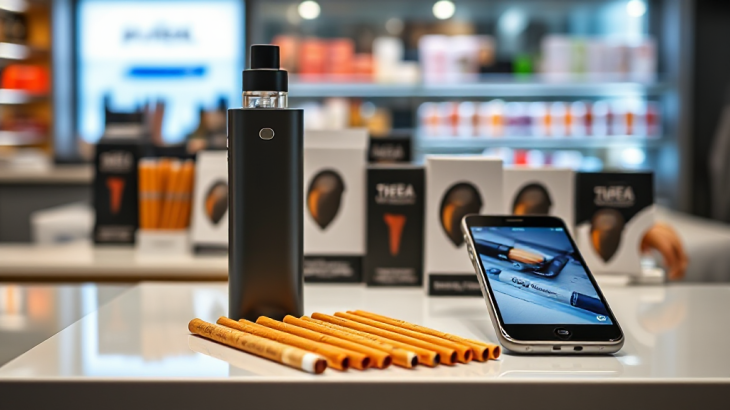
I Fix TEREA Delivery Tickets for a Living: What Actually Happens When You Buy TEREA Sticks Online
It is 07:40 on a Tuesday and the first ticket of my shift reads like this: “Ordered Thursday, tracking says customs since Saturday, I have two sticks left in the pack, what do I do.” I am the person who answers that ticket. I work support for a European heat-not-burn retailer, which means most of my week is spent inside the gap between a customer pressing pay and a courier actually handing over a box of TEREA sticks. That gap is where almost every frustration lives, and it is also the reason I can tell you with some confidence what a realistic, low-stress attempt to buy TEREA sticks online actually looks like from the inside.
This is not a marketing piece. It is a day-in-the-life account of the tickets I handle, the requirements that separate a smooth order from a stuck one, the procedure I walk people through, and the checks I run before I close a case. If you read it before you order rather than after, you will probably never end up in my queue.
What Lands in My Queue, and What Almost Never Does
I can sort my tickets into roughly four buckets, and the distribution has been stable for a long time. The first bucket is delivery status questions, which is about half of everything. The second is product compatibility, meaning someone bought sticks that do not fit the device in their hand. The third is payment friction, usually a card declined by the issuing bank rather than by the shop. The fourth is the smallest and most avoidable: address and name mismatches that cause a parcel to bounce.
What almost never lands in my queue is the thing people worry about most, which is authenticity. In years of handling these cases I have seen very few disputes about whether a sealed pack is genuine, and those were resolved quickly by batch information on the packaging. The reason is structural rather than heroic: TEREA sticks are a manufactured consumable with batch codes, foil seals and lot printing, and a retailer selling counterfeit stock would be caught by the first customer who compared a pack against a known one. The realistic risks in this category are stale stock, damaged packs and wrong-variant shipments, not fakes.
The other thing that almost never happens is a total loss. Even in the worst case I handled last year, a parcel that sat in a sorting hub for eleven days, the customer received the order. Late is common. Gone is rare.
Requirements Before You Order: The Five Things I Check First
When someone writes to me in a panic, the first thing I do is reconstruct their order from five data points. These are the same five things you should have settled before you click buy, because every one of them is a common failure cause.
One: device compatibility. TEREA sticks are designed for the IQOS ILUMA family, which uses induction heating rather than a blade. They are not the same product as HEETS, which fit earlier blade-based IQOS models. This is the single most common compatibility error I see, and it is entirely preventable. If your device has a heating blade that you insert into the tobacco, TEREA is not your stick. If your device uses a Smartcore induction system with no blade, TEREA is. Check the model number on the device body or in the app before ordering, not after.
Two: flavour variant. TEREA comes in a wide range, and the naming is not always intuitive. Dimensions, Amber, Yellow, Sienna, Russet, Teak, Mauve Wave, Oasis Pearl, Ruby Regular, Bright Wave and others sit on shelves together, and two variants with similar names can taste very different. If you are switching from another stick line, do not assume the colour name maps across. Read the description of the specific variant, and if you are unsure, order one pack of two or three variants rather than a full sleeve of one.
Three: quantity and freshness. Sticks are a perishable-ish product in the sense that they dry out over time once the pack is opened, and even sealed packs have a production date. If you are a heavy user, buying in larger quantities makes sense. If you are experimenting, it does not, because an open pack you dislike is money you will not get back. I routinely see people buy ten packs of a variant they have never tried, then write to me asking whether they can return opened packs. In most of Europe the answer is no, for reasons that are legal rather than stingy.
Four: delivery address and name. This is where the boring failures live. The name on the order should match the name on the ID you can produce if a courier asks. The address should be one where someone can actually receive a parcel during working hours, or you should have a pickup point selected. I have watched orders fail because an apartment number was missing, because a street name was spelled two different ways across the billing and shipping fields, and because someone shipped to a workplace that closed for a holiday week.
Five: payment method that your bank will actually allow. Tobacco-adjacent purchases are flagged by some card issuers, particularly on cross-border transactions. This is not the shop declining you. It is your bank applying a category rule. A card that works domestically may fail on an EU cross-border charge, and the reverse is also true.
The Procedure: What I Walk People Through, Start to Finish
Here is the sequence I give to anyone who asks how to do this properly. It takes about ten minutes and removes almost all of the risk.
Start by confirming your device family. Open the app or look at the device, find the model, and match it to the stick line. If you are on an ILUMA device, you are in TEREA territory. If you are on an older blade device, you are not, and no amount of clever ordering will fix that.
Next, decide your variant strategy. If you are new to TEREA, pick two or three variants that sound appealing based on their described profile, and buy one pack of each. Menthol-forward, tobacco-forward and the fruit-adjacent options are genuinely different experiences, and the only reliable test is your own palate. Once you know what you like, buy in larger quantities and stop paying shipping on single packs.
Then choose the shop. Look for a retailer that states its delivery footprint clearly, lists its payment methods, and publishes a returns or dispute policy you can actually read. A shop that is vague about where it ships from is a shop that will be vague about where your parcel is. Category pages that group sticks by device family and variant, rather than dumping everything into one grid, are a good sign that the operator understands the product.
Place the order with the address and name details I listed above. Use a payment method you have used successfully for cross-border purchases before, or have a backup ready. If your bank sends a verification prompt, complete it immediately rather than later, because an unverified transaction will sometimes sit in a pending state and then drop.
After ordering, save the confirmation email and the tracking number somewhere you can find them without searching. The single biggest cause of a stressful support ticket is a customer who cannot locate their order number and therefore cannot be helped quickly. If tracking does not update within the expected window, contact the shop before contacting your bank. A chargeback is a slow, blunt instrument and it usually delays the parcel rather than accelerating it.
When the parcel arrives, check the packs before you open them. Seals should be intact, batch printing should be legible, and the variant should match what you ordered. If something is wrong, photograph it immediately, before opening anything. A photo of a sealed, mislabelled pack is worth ten paragraphs of description.
What I Check Before I Close a Ticket
Every case I handle ends with the same checklist, and you can run it yourself to predict whether your order is on track.
First, has the parcel actually moved, or is it only the tracking page that has not updated? These are different problems. A tracking page that has not refreshed in three days is often a scanning gap, not a stalled parcel. A parcel that has genuinely not moved in seven days is a real issue. I check the carrier’s own tracking, not the shop’s summary, because the summary is sometimes a day behind.
Second, is the delay on the shop’s side or the carrier’s side? If the order has not been marked as dispatched, that is on the shop, and the fix is a message to the shop. If it is dispatched and sitting in a hub, that is the carrier, and the shop’s ability to help is limited to opening an investigation. Knowing which one you are dealing with saves a lot of misdirected anger.
Third, is there a customs or duty question? For cross-border EU shipments, most delays in this category are documentation checks rather than actual charges, and they resolve on their own. If a charge is genuinely due, the carrier will contact you. If you receive a message demanding payment through an unusual link, do not pay it. Verify through the carrier’s official site first.
Fourth, is the address correct on the label? If it is not, the parcel will return to sender and be re-shipped, which adds a week. This is why I ask people to double-check before ordering rather than after.
Fifth, has the customer already tried the obvious things? A surprising number of tickets are resolved by clearing a browser cache, checking a spam folder for the confirmation email, or logging into the account rather than using a guest order lookup. I always ask before I escalate, because escalation without those steps wastes everyone’s time.
Where People Get Burned, and How to Avoid It
The failures I see are rarely dramatic. They are small, boring and cumulative.
The most common is ordering the wrong stick line. Someone searches for TEREA, finds a good price on a similar-looking product, and buys HEETS or a compatible alternative without checking the device. The packs arrive, they do not fit, and the return is complicated because the product is a tobacco consumable. The fix is thirty seconds of checking before purchase.
The second is bulk-buying an untried variant. A sleeve of ten packs is a meaningful commitment. If you dislike the flavour, you are stuck with it. Buy singles first.
The third is ignoring the delivery window. If you are travelling, or if you are down to your last two packs, order earlier than you think you need to. Cross-border delivery has a long tail, and the tail is where the stress lives. I have never once had a customer complain that their order arrived too early.
The fourth is paying with a method that fails silently. A declined card that the customer does not notice can leave an order in limbo for days. If your order confirmation has not arrived within an hour, check your spam folder and then check your bank app. Do not assume it went through.
The fifth is treating support as an adversary. The person on the other end, in most cases, wants your parcel to arrive. Give them the order number, the tracking number, a clear description and a photo if relevant, and you will get a faster resolution than a paragraph of frustration.
Closing the Case: What a Good Order Feels Like
The tickets I like closing are the boring ones. Customer orders on a Monday, tracking updates on Tuesday, parcel arrives Thursday, no contact required. That is the outcome the whole system is designed for, and it is achievable almost every time if the five requirements are met before checkout rather than after.
My honest advice, after handling more of these cases than I can count, is to treat the purchase as a logistics exercise rather than a shopping one. Confirm the device, pick a small first order, use a payment method that works cross-border, give an address where someone is actually present, and keep your confirmation email. Do those five things and you will almost certainly never need to speak to someone like me.
And if you do end up in my queue, bring the order number. It is the single most useful thing you can hand me, and it turns a twenty-minute back-and-forth into a two-minute answer.